Quran proves - "Allah" is NOT a 'moon
god':
"And from among His Signs are the night and
the day, and the sun and the moon. Do not bow down (prostrate)
to the sun nor to the moon, but only bow down (prostrate) to
"Allah" Who created them, if you (really) worship Him."
[Quran 41:37]
The Christian acquaintance who sent me a copy
of Morey's booklet also sent me five questions related to this
subject. I will attempt to answer them below:
Question 1:
What is the significance of the
crescent moon in Islam?
Answer:
The Qur'n answers this question before you
asked it. Read this verse:
They ask you about the new moons.
Say: These are signs to mark fixed periods of time for
mankind and for the pilgrimage (Qur'n
2:189).
Question 2:
Why does Islam follow a lunar
calendar?
Answer:
In both the Bible and the Qur'n
religious festivals are regulated by the lunar calendar.
Jews and Muslims have kept to these regulations which they
believe to be from God. Why does Christianity follow a solar
calendar?
Question 3:
Why is the feast of Ramadan marked
by the appearance of the crescent moon?
Answer:
I think you mean the fast of Ramadan. God
commanded Muslims in the Qur'n to fast from dawn to sunset
during the month called Ramadan (see Qur'n 2:185, 187). The
beginning and end of the month is determined by the crescent
(2:189) based on the instruction of God's Messenger, on whom
be peace.
Why this method and not another is not for
us to say but for God and His Messenger to prescribe.
However, I find it an efficient method. It is a universally
applicable method, and it allows for Ramadan to move through
all the seasons. This allows believers to have the pleasure
of worshipping God by fasting in all the various seasons:
one year in the summer, some years later in the
winter.
Question 4:
Why does the Quran place the
Sabeans on the same level with Jews and Christians when
scholars have clearly proven that the Sabeans were involved in
the moon cult?
Answer:
I am not aware that the Qur'n has placed
the Sabeans on the same level with Jews and Christians.
Perhaps you have in mind the following verse:
Those who believe and those who are Jews and
Christians and Sabians, whoever believes in "Allah" and the
Last Day and do righteous good deeds shall have their reward
with their Lord. On them shall be no fear, nor shall they
grieve. (Qurpan 2:62; also 5:69).
This verse, however, does not place the
Sabeans on the same level as the Jews and Christians except
in a particular context. The verse speaks of four distinct
communities, and offers all four the opportunity to fear not
nor grieve if only they would believe in "Allah" and the Last
Day and do right. The four communities are:
(a) the Believers (i.e., the Muslims)
(b) the Jews
(c) the Christians and
(d) the Sabeans.
While they are all offered the same
opportunity for improvement, nothing, is said in this verse
about the validity of the existing faiths of these four
communities. Otherwise the Jews and Christians who are
criticized in the Qur'n for their deviations will not be
placed on the same level with the believers. The matter
becomes clear when you realise that believers here does not
mean saved persons but those who ostensibly belong to the
community of Muslims. They, as well as the other three
groups, must do the following to be saved: believe in "Allah" ,
believe in the Last Day, and do right. Doing right,
according to the Qur'n, includes following every teaching
of Muhammad.
Questions 5:
Did the Meccans worship the true God
since they recognized "Allah" ? Was "Allah" one of the gods of
the Ka'bah? And if so, where did the Meccans derive the
recognition and the name of "Allah" from?
Answer:
First, "Allah" was not one of the 360 idols
which were in the Ka'abah, although Morey has claimed this
without evidence. When the Prophet Muhammad (pbuh)
entered Meccah victorious he went into the Ka'abah and broke
the idols therein.
Second, the word "Allah" has been used all
along for the name of "God" in the Arabic Bible for Jews and
Christians alike. The proof is easy to verify; simple go to
any hotel or motel on the earth and look in the drawer next
to the bed and take out the complimentary Bible, placed
there by the Giddeons and then look on page 5 or 6 where
they list the examples of translations they have made into
other languages. The second example given is for Arabic
speakers. The verse is from the Gospel of John, chapter 3,
verse 16. Everyone knows this one; "For God so loved the
world..." and the word in Arabic for "God" is "Allah." Then
if you have a Bible in Arabic, look on page one in Genesis,
and you will find the word "Allah" fourteen times.
Next, the word for "God" to the Arabs, ever
since the time of Abraham, peace be upon him, has been
"Allah" and He is to them, the Lord of the Ka'bah (the black
box in the center of the Holy Sanctuary in Makkah). He was
the unseen God whom they would call upon when in distress.
Yes, they worshipped the true God but their worship was not
purely for Him. They also worshipped other gods thinking
that they would act as intermediaries between them and the
true God Allah.
The Arabs know of Allah because Abraham
visited Meccah and together with his son Ishmael laid the
foundation of the Ka'abah. The descendants of Ishmael
retained some of the worship rites and beliefs from Abraham.
This included their knowledge of the true God Allah.
Elsewhere we have shown conclusively that the
true god, "El" of the Bible is the same as "Allah" of the Quran.
Please refer to: "Yahweh, Jehovah, or Allah - What Is God's Real Name?" by Sheikh Shabir Ally.











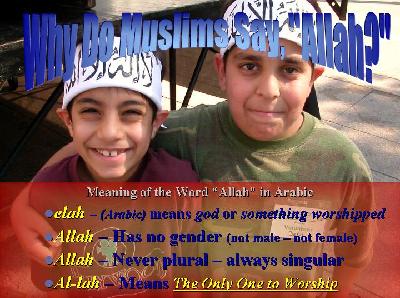
![How Do We Understand "<strong>Allah</strong>"? His Nature? His Existence? [click]](../allah/proving_God_files/Allah_Does_It_Mean_God.jpg)



![Free Quran [click here]](../allah/proving_God_files/quran_small_free.jpg)