Women Treatment in Islam
We receive many questions about the treatment of women in Islam in general and what Muslim men do with their wives in particular. The following should help to shed some light on this most important subject.
Question:
I have a question about the treatement of the women in Islam. Could you please tell us why the Quran tells men to "beat them" meaning their wives? (chapter 4, verse 34)
Answer:
Thank you for asking about Islam. It is our committment to try our best to provide answers to questions to the best of our ability. However, sometimes we come across questions for which we do not have answers. In this case we will refer you to others who may be able to provide you with proper answers.
First of all please be aware that we as Muslims, must never lie about anything, especially our religion.
Secondly, we do have the original text of the Quran and the preserved teachings of Muhammad, peace be upon him. This enables us to verify exactly what was said, intended and taught by Muhammad, peace be upon him, as being the religion of Islam.
Third, I would like to remind myself and all who read this in the future that not all questions are purely questions. Some contain statements and implications, that may or may not be true.
Finally, it is important to keep in mind anytime we discover something in the answers to actually be better than what we already have, we should be committed to change our position and accept that which is true over that which is false and take that which is better for that which is inferior.
After taking all of the above into consideration, if we find that the answer to this question provides us with a better approach to understanding what Almighty God has provided us with as a way of life on this earth and in the Next Life, we should then make the logical decsion to begin to worship Him on His terms.
Having said that, let us now look to the particular verse in question in the original text (Arabic), followed by the phonetic sounds in Latin letters and then finally, followed by a translation of the meaning to the English language by experts in both Arabic and in Quranic meanings.
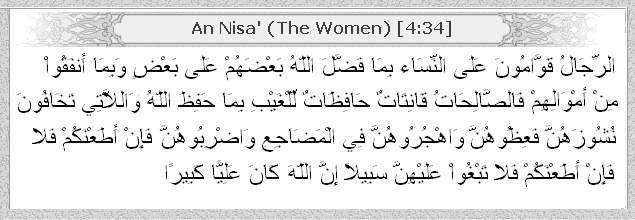
Transliteration
Ar-rejalu qawwa muna 'alan-nisa'a bima fadhdhallahu ba'dhahum 'ala bi'dhi wa bima anfaqu min amwalihim. Fas-saliHatu qaintat HafaTHatul-lilghaybi bimaa HafiTHal-lahu, wal-lati takhaafuna nushuza hunna fa'iTHuu hunnaa wa hjuruu hunna fiil-lmadhaa ji'i wadhribu hunna. Faa'in aTa'nakum flaa tabghuu 'alayhinna sabiilan. Innal-laha kaana 'aliyaan kabiira(n).Explanation (tafsir) of Sura 4:34
“Men are the support of women as God gives some more means than others, and because they spend of their wealth (to provide for them). So women who are virtuous are obedient to God and guard the hidden as God has guarded it. As for women you feel are averse, talk to them suasively; then leave them alone in bed (without molesting them) and go to bed with them (when they are willing). If they open out to you, do not seek an excuse for blaming them. Surely God is sublime and great.”Meaning of the Words
For the three words fa'izu, wahjaru, and wadribu in the original, translated here 'talk to them suasively,' 'leave them alone (in bed - fi'l-madage'),' and 'have intercourse', respectively, see Raghib Lisan al-'Arab and Zamakhsari. Raghib in his Al-Mufridat fi Gharib al-Qur'an gives the meanings of these words with special reference to this verse. Fa-'izu, he says, means to 'to talk to them so persuasively as to melt their hearts.' (See also v.63 of this Surah where it has been used in a similar sense.)Hajara - Wahjaru (do not touch or moleste them)
Hajara, he says, means to separate body from body, and points out that the expression wahjaru hunna metaphorically means to refrain from touching or molesting them. Zamakhshari is more explicit in his Kshshaf when he says, 'do not get inside their blankets.'Daraba (to have intercourse, not to beat)
Raghib points out that daraba metaphorically means to have intercourse, and quotes the expression: "Darab al-fahl an-naqah" - 'the stud camel covered the she-camel,' which is also quoted by Lisan al-'Arab.
It cannot be taken here to mean 'to strike, hit or beat them (women).' This view is strengthened by the Prophet's authentic hadith found in a number of authorities, including Bukhari and Muslim:
"Could any of you beat your wife as he would a slave, and then lie with her in the evening?" There are other traditions in Abu Da'ud, Nasa'i, Ibn Majah, Ahmad bin Hanbal and others, to the effect that he forbade the beating of any woman, saying: "Never beat God's handmaidens."Source:
Al-Qur'an: a contemporary translation by Ahmed Ali, Princeton University Press, 1988; pp78-79In the past, some translators of this verse have mistakeningly used the word "beat" to represent the word "dhaaraba" in Arabic. This is not the opinion of all scholars especially Raghib and Zamakhshari as mentioned above and those who are well grounded in both Islam understanding and the English language.
Quran: (Surah An-Nisaa' [The Women] 4:34)
Men are the protectors and maintainers of women, because Allah has made one of them to excel the other, and because they spend (to support them) from their means. Therefore the righteous women are devoutly obedient (to Allah and to their husbands), and guard in the husband's absence what Allah orders them to guard (e.g. their chastity, their husband's property, etc.). As to those women on whose part you see illconduct, admonish them (first), (next), refuse to share their beds, (and last) beat them (lightly, if it is useful), but if they return to obedience, seek not against them means (of annoyance). Surely, Allah is Ever Most High, Most Great.We understand from this some of the translations are not properly representing the spirit of the meaning. Therefore, they cannot be considered to be the representation of what has been intended by Almighty God.
Now we can properly understand that Almighty God has commanded the men to provide for the women and allow them to keep all of their wealth, inheritance and income without demanding anything from them for support and maintenance. Additionally, if she should be guilty of lewd or indecent conduct, the husband is told to first, admonish her and then she should cease this lewdness. However, if she should continue in this indecency, then he should no longer share the bed with her, and this would continue for a period of time. Finally, if she would repent then he would take up sharing the bed with her again.
Dr. Jamal Badawi (St. Mary's University, Nova Scotia) is of the opinion these (three stages) are necessary steps prior to divorce. Instead of a man saying, "I divorce you" three times in a row, he should follow this procedure before acting hastily and thereby doing something unwise and displeasing to Allah. The first step would be as mentioned above, to give her a "good talking to" and then if she continued in such unpleasing behavior, to leave the bed (not have intercourse with her) for a period of time and then finally, the last straw would be to "tap" her on the arm with a "tooth stick" or something of this size and nature to signify to her this is the final straw and then if she still persisted in her bad way, he could divorce her.
Regardless of the various positions and opinions, there is no permission establish through the teachings of the Quran or the Sunnah (way) of Muhammad, peace be upon him, wherein one person could "beat" another person.
And Allah is All Knowing of the meanings.